Place du Châtelet
Les MisérablesPlace du Châtelet connects the machinery of policing with the exposed riverbank where Javert confronts a decisive choice. In the darkness after midnight, the square gives him a route from the parapet to a police post and back again. Its importance lies in that contrast: within the post, he writes in the ordered language of administration; outside, he resumes his solitary position above the fast water of the Seine.
Setting and position
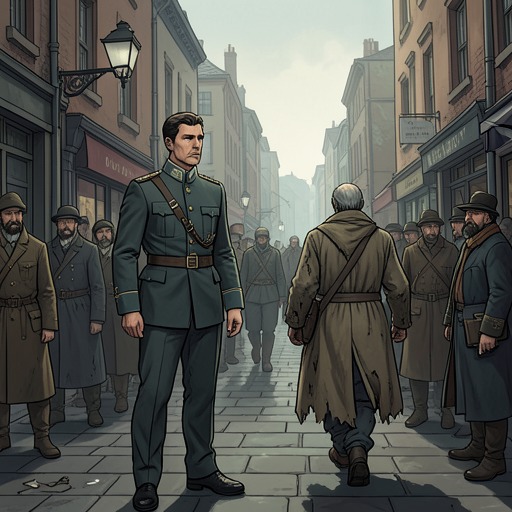
The scene places the police post at one corner of Place du Châtelet, identified by a lantern. Javert leaves the parapet and walks firmly toward it, then sees a city sergeant through the window and enters. The location is therefore not merely an open square: it includes a point of official entry, where Javert can identify himself to another officer and take up the familiar procedures of the police.
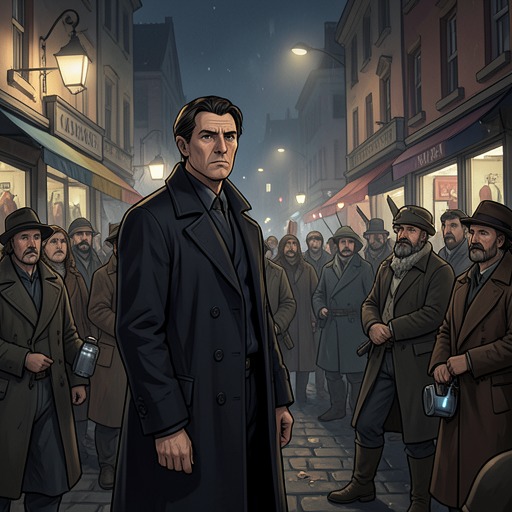
The surrounding city is described as nearly emptied of signs of life. Clouds conceal the stars, the houses on the Île de la Cité have no lights, and nobody passes along the streets or quays. Notre-Dame and the towers of the Palais de Justice are reduced to outlines in the darkness; a streetlamp reddens the quay’s edge, while the bridges recede in distorted silhouettes through the mist. These details define the square and its neighboring riverbank through visibility and absence: landmarks remain, but the ordinary life that would make them legible has disappeared.
The police post and its paperwork
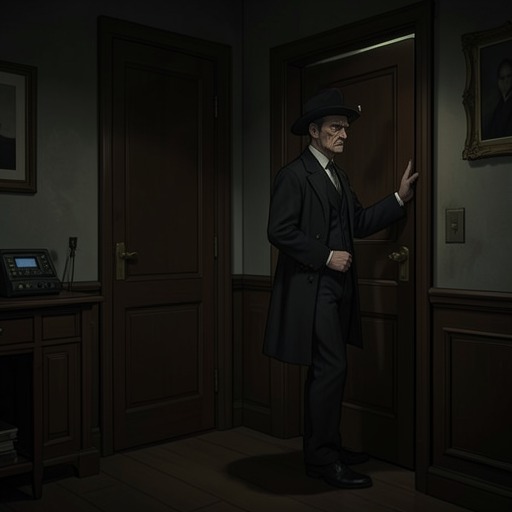
Inside the post, Javert names himself, shows his card, and sits at a table lit by a candle. The objects on it are plain instruments of administration: a pen, a lead inkwell, and paper kept for possible reports and records of night patrols. The room gives him a place to convert his observations into writing. He takes a sheet and begins a memorandum addressed to the interests of the service.
The narrative pauses over the table as a standard feature of police posts. Its straw chair, wooden saucer filled with sawdust, and cardboard container of red sealing wafers belong to a repeated institutional arrangement, not to a specially furnished room. The narrator presents this furniture as the base level of official style, where the state’s written language begins. In the square, then, the police presence is made concrete not by an arrest or a pursuit, but by a desk, office supplies, and the forms through which an officer can address his superiors.
Javert writes with calm, correct handwriting, taking care over punctuation and pressing firmly enough for the pen to make the paper creak. The surviving details of the memorandum show its administrative scope: its first item begins a set of observations for the service, while its tenth comments on Mme Henry, whose canteen is described as clean, and objects to a woman staffing the entrance to a secret holding place. Javert signs as a first-class inspector at the Place du Châtelet post and dates the document at about one in the morning on 7 June 1832. He dries the ink, folds and seals the sheet, labels it for the administration, leaves it on the table, and goes out.
From the square back to the Seine
After leaving the post, Javert crosses Place du Châtelet diagonally, returns to the quay, and reaches the exact point he had left about a quarter of an hour earlier. He leans against the parapet in the same posture, on the same slab, so that from the outside he seems scarcely to have moved. The movement has taken him through the police station and its official routine, but it has returned him to the brink rather than carrying him away from it.
The parapet stands directly above a rapid section of the Seine, over a whirlpool that repeatedly coils and uncoils. Rain has swollen the river, and the darkness conceals the surrounding city while leaving the dangerous current beneath Javert’s position. Place du Châtelet thus marks the physical relationship between two different forms of order: the carefully arranged documents of the police post and the force of a river that cannot be managed by paperwork. The scene’s route across the square and back to the parapet makes the location central to Javert’s passage from public duty to solitary crisis.